The Loneliness Paradox and the Case for Quiet Presence

On classical music, cognitive bandwidth, and why we need a new socio-spatial architecture for listening.

By Dr. Clara Haneul Yoon

We are living through a quiet contradiction. We have become hyper-connected through our screens—driven by a deep-seated desire to be "seen"—yet we find ourselves increasingly isolated in physical space. We say we want a "village," with an almost ancestral desperation, but the conditions of modern social life often leave us too depleted to pursue it.

The prospect of making new connections has become a calculation of social labor. To show up is to be articulate, energetic, responsive, and socially fluent. For those already navigating cognitive overload, meeting people feels less like an invitation and more like an unpaid shift. We are overdrawn on the social currency needed to engage; it’s a paradox in which proximity is made inaccessible by the very rituals meant to produce it.

The Weight of the Ritual

In theory, classical music should be the reprieve. In a world brimming with digital noise and self-promotion, the concert hall still asks one thing of its audience: to listen. It offers a collective surrender to stillness, and for the overextended, this should feel like a sanctuary.

But traditional concert settings carry their own form of strain. The experience is governed by a dense web of unwritten rules: how to dress, when to applaud (or pointedly not), how still to sit, and when silence is sacred versus expected. There are, of course, “casual” formats, but the underlying codes often remain intact, and these rituals demand a particular kind of ease within a formal social grammar.

What we call reverence often functions, in practice, as vigilance. The stillness meant to house the music ends up holding the listener. To be held by sound, alongside others, remains more as a ghost of an idea—a village glimpsed only through the glare of its own gatekeeping.

Where Attention Is Spent

Our capacity to listen deeply is shaped as much by the environment as by the music itself. Every space allocates cognitive bandwidth long before the first note is played. The question is not whether we are capable of processing complex music, but how much mental energy remains once the social conditions of the room are accounted for.

In formal concert settings, much of our attention goes to self-regulation. We monitor everything: Am I clapping between movements? Should I have waited? Is my breathing too loud? Did my coat just rustle? We perform attentiveness even when our minds wander. None of it is malicious or wrong. But it does come at a cost. When attention is spent on “doing it right,” less remains for perception itself, and listening becomes fragmented.

This is especially true for the introverted or, let’s be honest, the chronically burnt-out. In 2026, that exhaustion has moved from a diagnosis to a collective default. What the music requires is attention, but attention is not the same as vigilance. Attention is generous, curious, absorptive. Vigilance is contracted, self-monitoring, defensive. One invites you in. The other keeps you at a remove.

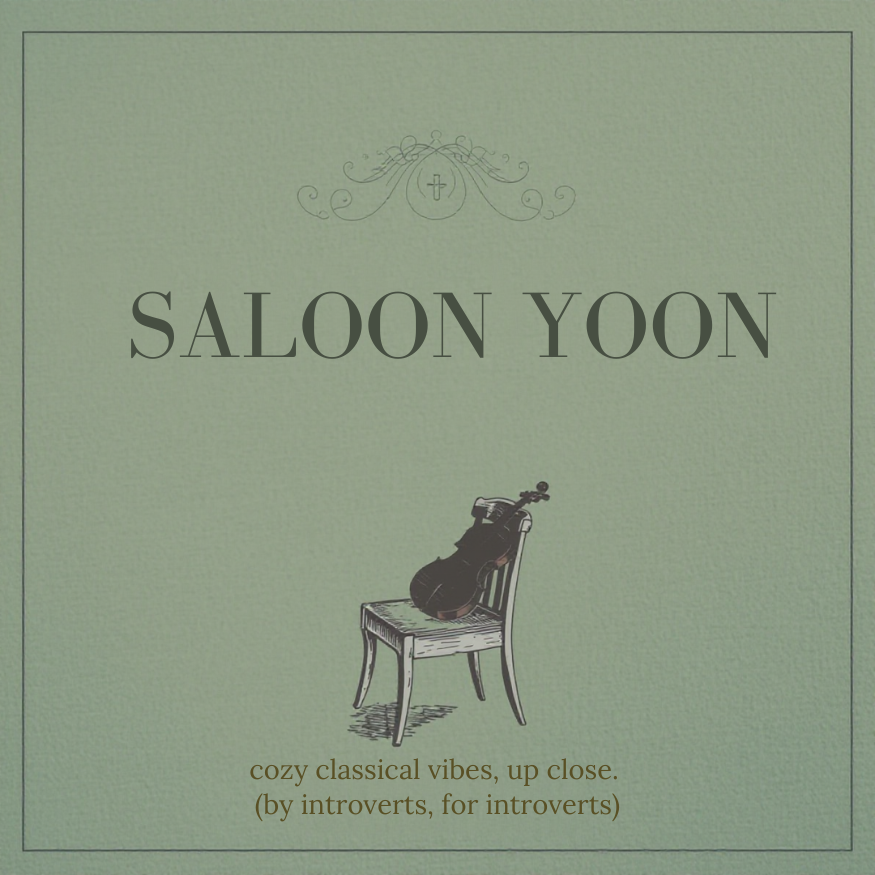
Saloon Yoon: By Introverts, For Introverts

There is a subtle, persistent asymmetry in how we occupy these spaces day to day. Extroverts are rarely asked to quiet their spirit, yet introverts are consistently asked to "speak up," to perform a social vitality that may not be on cue. We have built our cultural cathedrals around the outgoing, leaving those who process the world quietly to do the heavy lifting of adaptation.

As a well-practiced introvert who socially comes across as an extrovert, yet needs the quiet to realign, I started the Saloon Yoon series in 2022 with a single question: what happens if the music remained demanding, but the environment softened?

Classical music doesn’t need the strict social architecture that has historically policed it. Bach is unharmed by a minor fidget, and Debussy’s nuance will (always) survive a cough. The music itself is remarkably resilient, but our access to it has grown fragile. The culprit is not the repertoire, but the inherited spaces we occupy—the codes and expectations that quietly tax the mind before the performance begins.

🌿 Quiet Scores (Launching Spring 2026)

In spring 2026, we are launching Quiet Scores, a sub-series for the quietly curious. Here, the environment is deliberately gentle: softly hued lighting, comfortable seating, and the removal of social scripts or the expectation of small talk. The Saloon Yoon series is a recalibration, and the premise is simple: it’s a space where your nervous system can settle and your mind can meet sound on its own terms; a place where you can just simply be.

__________

High level music. Zero level stress.

Our series is designed around your comfort and calm, so capacity is intentionally limited. If you would like to be notified of upcoming sessions, or if the idea of a shared, unhurried presence resonates with you, please join our waitlist below. You will be the first to hear about our 2026 calendar and the launch of the Quiet Scores sub-series.